Talking Point #07 - How Many is Too Many?
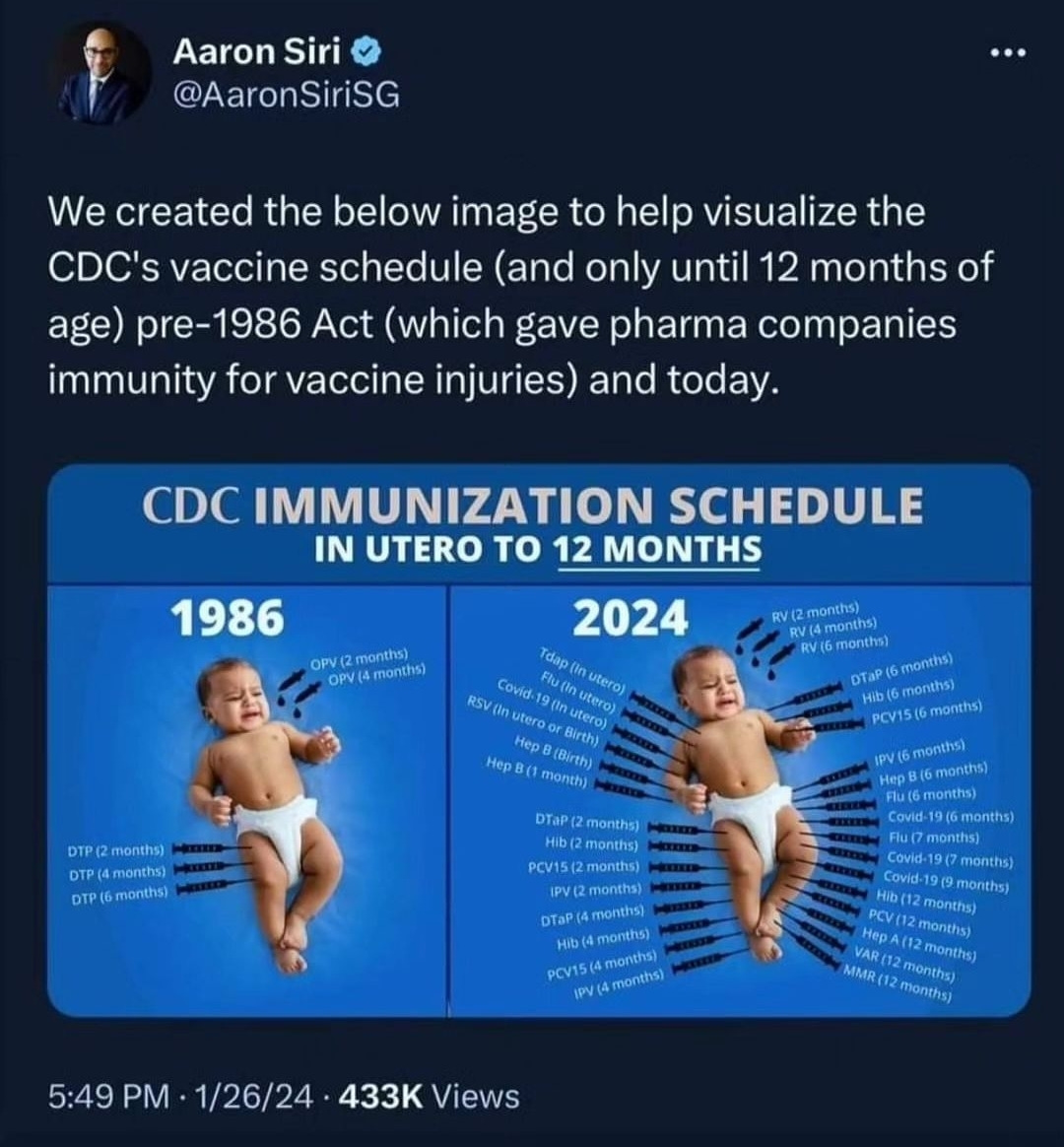
How about 35 by the age of 1 year old, or over 90 by the age of 18 years old?

October is Vaccine Injury Awareness Month, and with Alexis Lorenze’s story of vaccine injury going viral on social media, it’s time to update the VaxSafety.org website, this Substack, and my new Instagram! I’ll be posting 60 talking points that break this conversation into easily digestible parts, making it accessible for everyone, even kids. So, let’s put on our black ribbons for awareness and spread the word. Feel free to share widely, and check back anytime for updates, as I’ll be adding more information as needed.

Do you know how many shots your child received before their first birthday? What about before they turned 18 years old?
When my daughter Scarlet was born, we adhered to the CDC’s recommended vaccination schedule provided by her pediatrician. By her first birthday, she had received 25 doses of 8 different vaccine antigens, often getting as many as 8 antigens in a single visit.
Today, the CDC schedule recommends administering up to 37 doses of 16 different antigens to babies aged 12 to 15 months. These antigens include Hepatitis B, Rotavirus, Diphtheria, Tetanus, Pertussis, Hib, Pneumococcal, Polio, Flu, Measles, Mumps, Rubella, Varicella, Hepatitis A, Covid, and now RSV.
By the time children reach age 6, they can expect to receive an additional 22 doses of vaccines, bringing their total to 59 doses. This includes 7 boosters administered between 15 months and 6 years old for diphtheria, tetanus, pertussis, polio, influenza, COVID-19, measles, mumps, rubella, and varicella, along with the addition of hepatitis A.
By the time children reach age 18, they can expect to receive an additional 34 vaccine doses, including 12 annual flu shots and 12 annual COVID boosters. This brings their lifetime total to 93 doses, covering 19 different antigens. Once children reach age 11, they become eligible for the HPV and Meningococcal vaccines and transition from the DTaP shot to the TDaP shot, which is used for adults.

This is a summary of the Recommended Child and Adolescent Immunization Schedule for all children ages 18 years or younger in the United States in 2024
Respiratory syncytial virus (RSV) - 2 doses
Hepatitis B (HepB)- 3 Doses
Rotavirus (RV5) - 2 or 3 Doses (depends on brand)
Diphtheria, Tetanus, Pertussis (DTaP) - 5 Doses x3 = 15 doses
Haemophilus Influenzae Type B (Hib) - 3 or 4 Doses
Pneumococcal Conjugate (PCV13) - 4 Doses
Inactivated Poliovirus (IPV) - 4 Doses
Influenza (IIV or LAIV4) - up to 19 Annual Doses
Covid (1vCOV-mRNA, 1vCOV-aPS) - up to 19 Annual Doses
Measles, Mumps, Rubella (MMR) - 2 Doses x3 = 6 Doses
Varicella aka: Chicken Pox (Var) - 2 Doses
Hepatitis A (HepA) - 2 Doses
Diphtheria, Tetanus, Pertussis (TDaP) - 1 Dose x3 = 3 Doses
Human Papillomavirus (HPV) - 2 or 3 Doses
Meningococcal (MenA) - 2 Doses
Meningococcal (MenB) - 2 Doses
This totals 93 doses of 19 antigens. When is enough, ENOUGH!
https://www.cdc.gov/vaccines/hcp/imz-schedules/child-adolescent-age.html